When the Backup Plan Breaks Down: The Anatomy of a Last-Minute Transportation Crisis
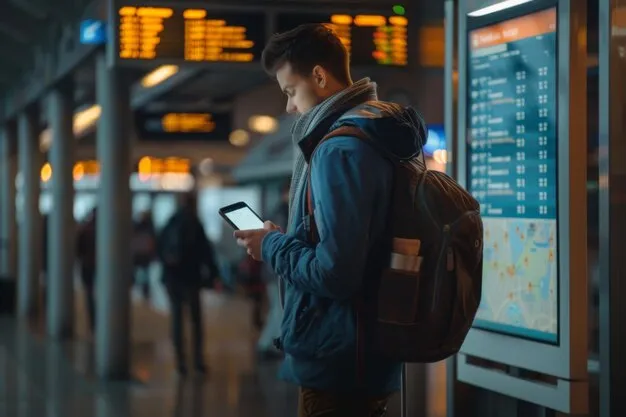
Photo: stressed traveler using smartphone at busy airport terminal during flight delay, via img.freepik.com
There is a particular kind of stress that arrives not at the moment a flight is canceled, but thirty seconds later—when the traveler reaches for their phone and realizes they have no reliable way to get where they need to go. The flight itself is almost secondary. The real problem is the gap between the airport and the destination, and the improvised scramble that fills it.
For millions of American travelers, that scramble has become a familiar ritual. A weather delay in Denver, a missed connection in Atlanta, a mechanical hold at O'Hare—and suddenly the carefully arranged itinerary becomes a test of resourcefulness that most people are not truly prepared to pass.
The Illusion of Availability
The dominant assumption among modern travelers is that transportation is always available. Ride-share apps have reinforced this belief powerfully. Open the app, see the pins on the map, and conclude that a car is minutes away. Under normal conditions, that assumption holds. Under disrupted conditions—the precise moments when reliable transportation matters most—it does not.
When a large flight is canceled and two hundred passengers simultaneously open the same app, the dynamics shift immediately. Surge pricing activates. Driver availability drops as demand spikes. Wait times that would ordinarily read as four minutes stretch to forty-five. Travelers who expected a seamless alternative find themselves bidding against each other in a market that has no obligation to serve them promptly or affordably.
A traveler stranded at Dallas/Fort Worth during an ice storm in February 2021 described the experience succinctly in an industry forum: the app showed cars nearby, but none accepted the ride. The surge multiplier climbed past three times the base fare before a driver finally confirmed. The total cost exceeded what the original flight ticket had cost.
This is not an edge case. It is the predictable behavior of an on-demand system encountering concentrated, simultaneous demand.
The Rental Counter Mirage
For those who distrust ride-shares, the rental car counter presents itself as the sensible alternative. It feels more formal, more dependable—a physical desk staffed by actual people. During a disruption, however, that desk becomes one of the most contested pieces of real estate in any airport.
Rental inventories are managed tightly. Companies do not maintain large fleets of idle vehicles waiting for emergencies. When cancellations are widespread, inventory disappears within the first hour. Travelers who arrive at the counter two hours after a mass disruption frequently find nothing available—not in the standard categories, not in the premium tiers, not at any price.
The traveler who assumed the rental desk was a reliable fallback has now lost both time and options. The taxi queue, meanwhile, has grown considerably.
Missed Connections and the Compounding Effect
The damage from a failed backup plan rarely stops at inconvenience. It compounds. A business traveler who misses a ground connection to a client meeting does not simply reschedule the meeting—they absorb the reputational cost of the missed commitment, the logistical cost of rescheduling, and often the financial cost of rebooking accommodations or additional travel segments.
Consider a scenario that plays out regularly across major hub cities: a traveler lands in Charlotte after a two-hour delay, needs to reach a meeting in Raleigh, and has no pre-arranged ground transportation. The drive is roughly two and a half hours under normal conditions. In the absence of a confirmed transfer, the traveler spends forty minutes attempting to arrange improvised options, eventually settles for a significantly overpriced solution, and arrives late. The meeting proceeds, but the impression has already been made.
What is rarely calculated in these moments is the cumulative weight of that impression across a year of similar incidents. For frequent travelers and the organizations that support them, these are not isolated failures. They form a pattern.
Why Ad-Hoc Solutions Are Structurally Unsuited to Disruptions
The fundamental problem with improvised transportation is not that the options are poor under normal conditions. It is that they are designed for normal conditions. Ride-share platforms optimize for routine demand. Rental companies manage inventory to average utilization rates. Taxi dispatchers staff to predictable volumes.
None of these systems are built to absorb the sudden, concentrated demand that follows a large-scale disruption. They are not designed to guarantee availability, hold pricing steady, or prioritize a specific traveler's needs. They are transactional platforms operating in a competitive, real-time market.
A proactive transfer arrangement operates on an entirely different logic. When transportation is confirmed in advance—with a professional service that maintains dedicated capacity and communicates proactively around disruptions—the traveler exits the scramble entirely. The driver monitors flight status independently. Adjustments are made before the traveler lands. The gap between the airport and the destination is managed, not improvised.
The Proactive Approach: Removing the Crisis Before It Arrives
Pre-arranged ground transportation is not, at its core, a luxury consideration. It is a risk management decision. The traveler who confirms a transfer before departure has effectively purchased an option against the chaos of the unexpected. That option has a known cost. The alternative has an unknown cost that is almost always higher—in dollars, in time, and in the compounding effects of disruption.
For business travelers especially, the calculus is straightforward. The cost of a confirmed professional transfer is fixed and predictable. The cost of a failed backup plan—including the surge fare, the lost time, the missed commitment, and the residual stress carried into the next day's work—is neither fixed nor predictable, and it is rarely small.
The last-minute scramble feels like a problem that arrives without warning. In most cases, it is a problem that was created weeks earlier, in the moment when a traveler decided that transportation was something to figure out upon arrival.
Seamless journeys are not accidents. They are the result of decisions made before the journey begins.